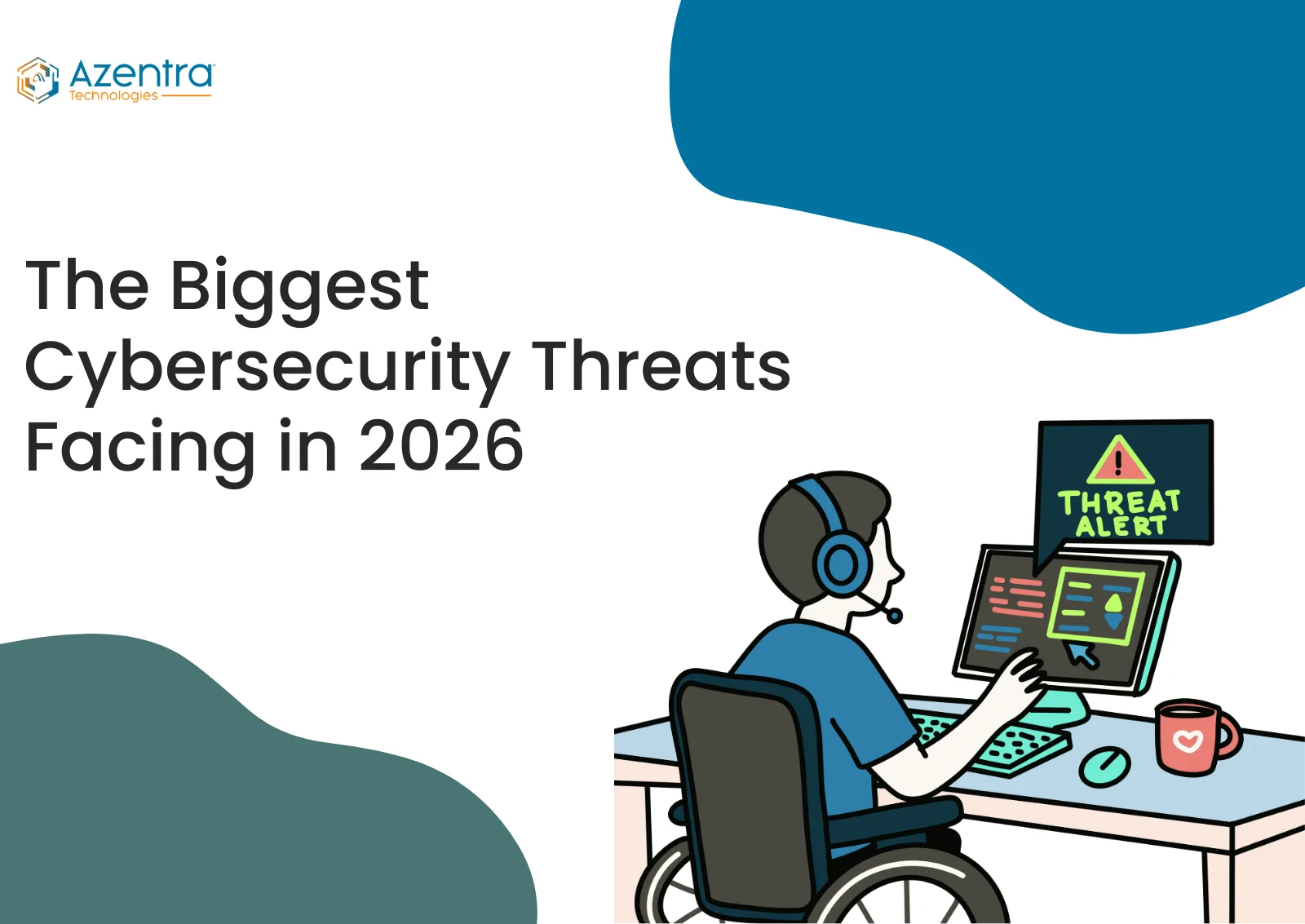
As we move into the year 2026, the Cyber threats are rising rapidly due to new technology such as AI automation technology, early quantum computing, and the massive increase in the number of connected devices.
Businesses across the globe are facing greater cybersecurity dangers like AI-driven hacking attacks and unknown vulnerabilities in supply chains. And for small businesses and big corporations, cyber threats are not just minor computer issues; they can be the biggest cybersecurity risks in 2026, that is damaging the business, result in financial loss, damage reputation, and shake customer trust with just one click.
And creating awareness of these risks can protect businesses. In this blog, we will discuss the most important business cybersecurity risks in 2026 and how Azentra Technologies will safeguard businesses against these threats.

AI-Powered Cyber Attacks: The Rise of Intelligent Adversaries
One of the most significant cyber threats in 2026 will be AI-powered cyber attacks. Cyber attackers are no longer just human beings typing away manually. Now, they can use AI tools to attack faster and smarter.
In 2025, it has already been witnessed that AI is used to function as digital robots that automatically test systems, learns and adapt their strategy. And, in 2026, the emergence of full AI hacker teams led to an increase in mimic attacks that are failing the human security teams.
This is particularly dangerous for small and medium-sized businesses, as they typically do not have the resources or sophisticated tools to protect themselves. Nowadays, AI attacks are difficult to detect, as they appear to be just normal traffic with normal user behavior.
Ransomware-as-a-Service (RaaS)
Ransomware is not a new threat, but Ransomware-as-a-Service (RaaS) has made it even worse as Cybersecurity threats 2026. Many cyber attackers can sign up for ransomware services, just like people sign up for Netflix, which has made it possible for less experienced hackers to attack businesses.
In 2026, RaaS has changed, where hackers target a business in a supply chain, like a supplier or a service provider, and then use this to spread ransomware to many of the supplier’s customers. This could potentially mean that one attack can harm dozens of businesses. The amount of ransom payments is also likely to increase. Sectors with high risks include the healthcare, manufacturing, and logistics industries.
Remote work is also an issue, as employees working through corporate VPNs from insecure home networks open doors for attackers.
Ransomware attacks are very hard to recover from, and even if the attacked organisation chooses not to pay the ransom, the consequences may include downtime, loss of business, and expensive recovery processes.
Phishing Scams and Deepfake-Driven Social Engineering
Phishing scams are the biggest cybersecurity risks in 2026 and are still one of the largest methods by which hackers gain access to companies in 2026. The new threat is deepfakes: fake videos, fake audio, and imitation voices created by AI. These are so realistic that they can fool people and even bypass security measures such as multi-factor authentication.
Vishing, or voice phishing, is now happening on a much larger scale because AI voice technology is now available at a very low cost, even on the dark web.
With people using video conferencing and calls, it becomes easier for fraudsters to pose as a high-ranking person. Deepfakes are exploiting the human’s trust.
Phishing in 2026 is no longer just about fake emails; it’s more about AI-driven scams that sound and look authentic.
Cloud Vulnerabilities in Hybrid and Multi-Cloud Environments
However, the adoption of hybrid and multi-cloud environments is a good thing, but it also poses huge cybersecurity risks.
It provides businesses with greater speed, flexibility, and scalability for better growth. But on the other hand, it increases the Business cybersecurity risks with the rise of security errors. Most cloud breaches are caused by security errors when users are granted excessive access permissions.
The risk is further compounded by the fact that remote work also poses a threat. Employees use unauthorised applications and services.
Zero-Day Exploits: The Unpredictable Wildcards
Zero-day exploits are hidden bugs in software that no one knows about yet, not even the company that produced the software. Since there is no fix for these problems, hackers can exploit them to gain access to a system before a fix can be put in place.
In 2026, zero-days are one of the largest threats to cybersecurity because it takes a long time for updates to be made.
For companies, the danger is increasing rapidly. Attackers can easily conduct one-click attacks with malicious online advertisements, compromised websites, or through malicious malware hidden in browser downloads.
Insider Threats and Supply Chain Attacks
Insider threats are not always intentional. Sometimes, employees are just careless. In 2026, this becomes a problem because people use AI automation tools such as chatbots or AI writing assistants, and they might accidentally paste or upload confidential company information. The AI tool might then save it, summarise it, or transmit it to an unsafe location.
Supply chain attacks are also becoming riskier. The biggest cybersecurity risks in 2026 are supply chains, as it has become more complex, with multiple levels of suppliers and partners. If a small third-party company gets hacked, this helps attackers to exploit other related businesses too.
Deepfakes are another danger. Then some scammers can use fake voices or videos to pose as trusted employees or executives.
IoT and Remote Work: Expanding the Attack Surface
In 2026, there will be approximately 75 billion IoT devices in use, including projectors, HVAC systems, and industrial machines. If these devices are not secured, hackers can control them, which results in a cybersecurity threat.
Remote work has taken over the market since the pandemic. Many workers use their personal laptops and smartphones, and that makes it easier for malware and cyber threats to enter the company’s systems.
As a result of more companies adopting hybrid work arrangements, companies require require better custom security systems, such as zero-trust security, which implies that one never trusts any user or device.
Conclusion: How Azentra Technologies Will Protect Your Business From Cyber Threats
At Azentra Technologies, we support organisations by handling their business cybersecurity risks and taking secure actions with our threat protection, zero-trust security design, endpoint security, and continuous monitoring services. Our offerings enable organisations to remain protected, compliant, and prepared for future cybersecurity threats.
Protect your business from the biggest cybersecurity threats of 2026. Contact Azentra Technologies today for a comprehensive security assessment and future-ready solutions aligned with the latest software development trends.